SWM strengthens partnership with Lenovo and NVIDIA: “Commercializing Level 4 robotaxis in Seoul and Gwangju in 2027”
- SWM unveils autonomous driving roadmap built on a “Global AI Alliance” at CES 2026
- “Successful demonstration completed in Gangnam, Seoul” — overcoming technical challenges and proving safety
- Level 4 robotaxi commercial service to expand to Seoul (Gangnam) and all of Gwangju Metropolitan City in 2027
- Close hardware/software collaboration with Lenovo and NVIDIA accelerates commercialization
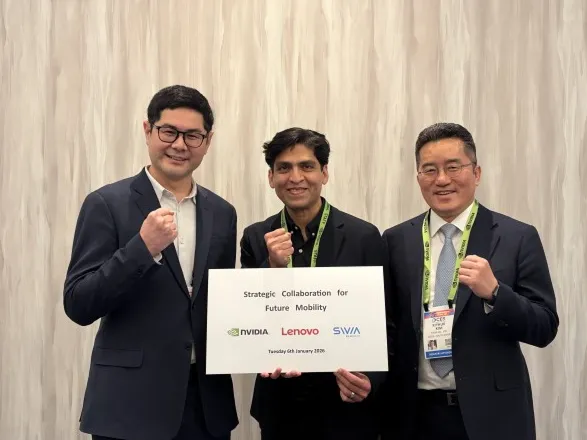
NVIDIA, Lenovo and SWM signed a three-way agreement at CES to strengthen cooperation in the automotive sector. (From left) Bingchuan Sun, Director of Vehicle Computing Business at Lenovo; Gaurav Agarwal, Director of Automotive Business at NVIDIA; and Kim Ki-hyuk, CEO of SWM.
SWM, a global leader in autonomous driving technology, announced that it has entered into a strategic partnership with Lenovo (HKSE: 0992) and NVIDIA (NASDAQ: NVDA) and is launching full-scale development and mass production of its high-performance computing platform, AP-700. AP-700 is an innovative autonomous driving system powered by the NVIDIA DRIVE AGX Thor platform, based on the Hyperion architecture that integrates the NVIDIA DRIVE AGX Thor in-vehicle computer. SWM plans to install this platform as the core controller in its Level 4 robotaxi, scheduled for release in 2026, accelerating its entry into the global autonomous driving ecosystem.
Best-in-class performance: The AP-700 platform, with a powerful 2,000 TOPS of computing power, combines Lenovo's AD1 L4 autonomous driving domain controller technology with a dual NVIDIA DRIVE AGX Thor configuration. It also adopts the NVIDIA Blackwell architecture to support computation optimized for transformer and generative AI workloads. This delivers up to 2,000 TOPS (2,000 trillion operations per second) of AI computing performance together with data center-class CPU performance in the safety-certified DriveOS environment, making it regarded as the most powerful of today's Level 4 autonomous driving platforms.
Safety and efficiency, with dramatic savings in cost and time: Optimized for generative AI and vision language models (VLMs), AP-700 delivers ultra-low-latency, millisecond-level responses even in unpredictable urban traffic, strengthening system stability and safety. On this technical foundation, AP-700 is being designed and developed to strict international safety standards to achieve full automotive-grade reliability, meeting ISO 26262 ASIL-D for functional safety, AEC-Q100 for reliability, and the ISO 21448 SOTIF guidelines.
With AP-700, SWM can dramatically improve on cost and time, long-standing challenges in the autonomous driving industry. Specifically, it aims to ▲ cut autonomous driving software development costs by 50% and ▲ shorten preparation time for Level 4 robotaxi commercialization by 40%. In particular, by ▲ laying the groundwork to reduce robotaxi (including the autonomous driving system) mass-production costs by up to 60%, it is expected to be a decisive turning point in bringing forward the commercialization of large-scale robotaxi services.
SWM said that through this three-way global partnership with Lenovo and NVIDIA, it has built a strong “Global AI Alliance.” Going beyond a simple technology tie-up, the partnership is expected to be an important bridgehead for SWM's entry into the global autonomous driving market as a key player. It is especially significant in that it fully establishes the technical and hardware foundation to achieve SWM's core goal of Level 4 autonomous driving commercialization in 2027. The combination of NVIDIA's high-performance AI computing power, Lenovo's reliable automotive hardware manufacturing capabilities and SWM's autonomous driving software technology is expected to produce the best possible synergy. SWM emphasized, “This strategic collaboration will be the signal flare for Korea's own robotaxi technology to enter the global market,” adding, “It will open an era of AI that people can feel firsthand, as ordinary Korean citizens will now be able to experience the fully driverless robotaxi services already commercialized in the U.S. and China.”
SWM has grown through continuous technological innovation over the past 20 years. It built a solid foundation in IT starting with feature phone software supply to Samsung Electronics in 2005, and since 2011 has supplied automotive electronics software to global automakers, accumulating essential know-how in vehicle safety and design. These technical assets led to the autonomous driving R&D program of the Ministry of Trade, Industry and Resources (MOTIR) in 2018, producing remarkable results in a short period. In 2020, together with the Korea Transport Institute (KOTI), SWM succeeded in Korea's first DRT (demand-responsive transit) autonomous public transport demonstration on a BRT route in Sejong City. The following year, in 2021, it became the first in Korea to obtain a limited autonomous driving transport license and has been stably operating a DRT service in Sangam, Seoul. Having pushed past technical limits by launching robotaxi demonstrations in 2024 in Gangnam, Seoul, Korea's most challenging urban environment, SWM is now ready to write a new chapter in Korean autonomous driving commercialization with the goal of expanding to nationwide service in 2026.